News
- Oct 2026 — EPO v1.4 adds one radial distortion term per camera, learned together with the focal length. Same speed per step, better poses: VGGT-Ω + EPO goes 68.4 → 86.8 AUC@5 on ScanNet++ (v1.3: 79.4) and 63.1 → 83.6 on TerraSky3D (v1.3: 81.2).
- Oct 2026 — EPO v1.3 now supports 3DGS reconstruction through ReSplat. With EPO poses, ReSplat achieves 24.2 dB PSNR on Mip-NeRF 360 in only ~47 s on a RTX 4090.
- Sept 2026 — EPO will be presented at the 3rd NeuSLAM [Nectar Track], ECCV 2026 Workshop, Sept 8, Malmö.
- Aug 2026 — EPO v1.2 is out 🚀 2.4× faster than v1.1, same accuracy. Refining 150 cameras takes less than 7 s on a RTX 4090.
- Jul 2026 — EPO v1.1 adds support for depth (re-)densification with Any2Full.
TL;DR
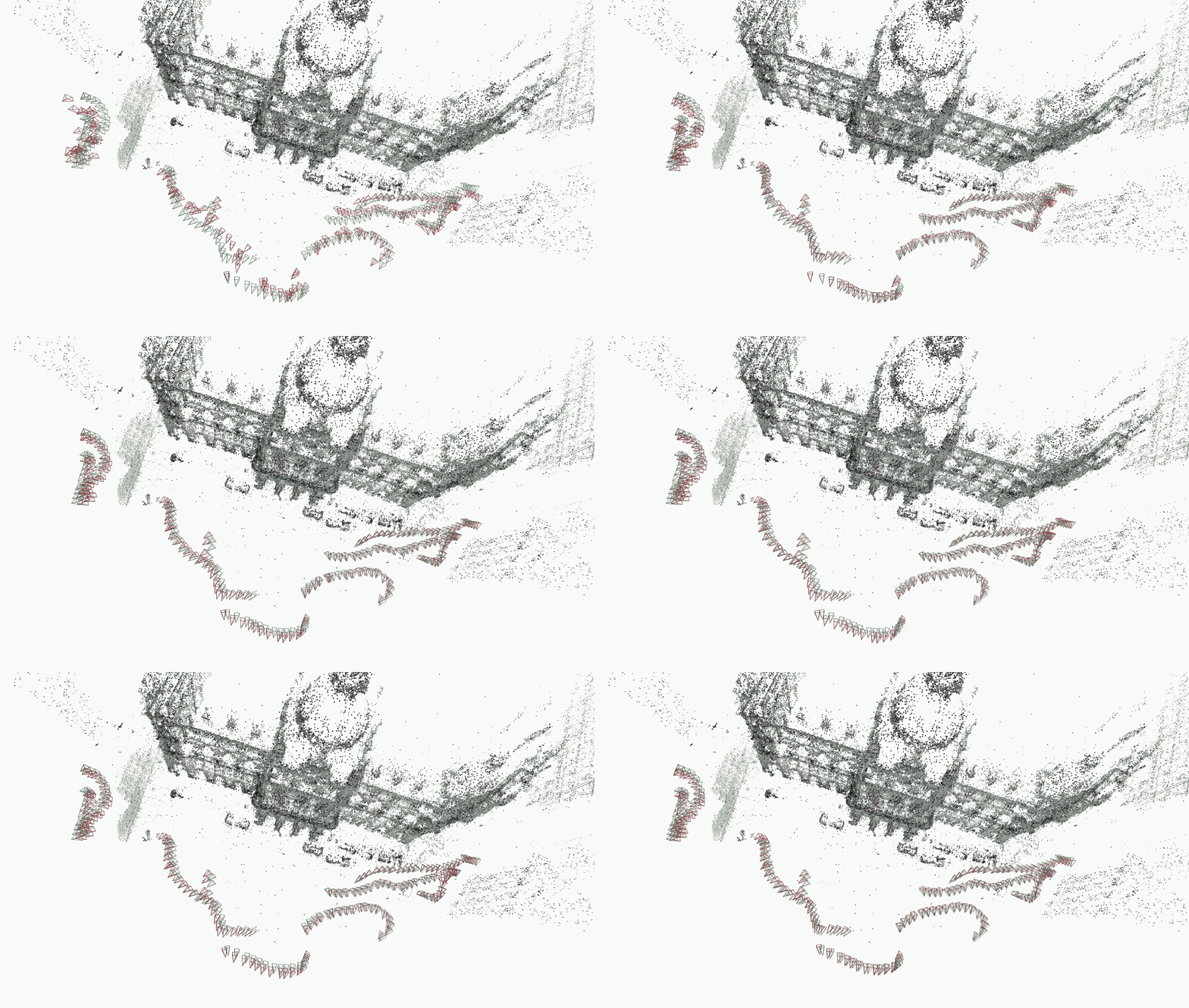
EPO runs on top of any 3D Foundation Model, skips feature extraction and matching entirely, and significantly improves the estimated camera poses in a fraction of the model’s own inference time. With densification, it gives back a dense output just like the one the 3DFM would produce — but with better geometry, thanks to the optimization. In short: faster, better, and denser than traditional Bundle Adjustment.
Contributions
- We propose a robust and trackless optimization framework that boosts the geometric accuracy of 3D Foundation Models through neural pose refinement and first-order optimization.
- We introduce an edge-based reprojection loss and a pose-based early-stopping criterion that together reduce runtime to a few seconds, compared to the minutes needed by Bundle Adjustment-based refinement methods, while requiring lower memory.
- We provide a comprehensive evaluation across diverse 3D Foundation Models, benchmarks, and real-world scenarios — including TerraSky3D, ScanNet++, and Mip-NeRF 360 — demonstrating that EPO consistently performs on par with, or superior to, state-of-the-art refinement methods.
How It Works
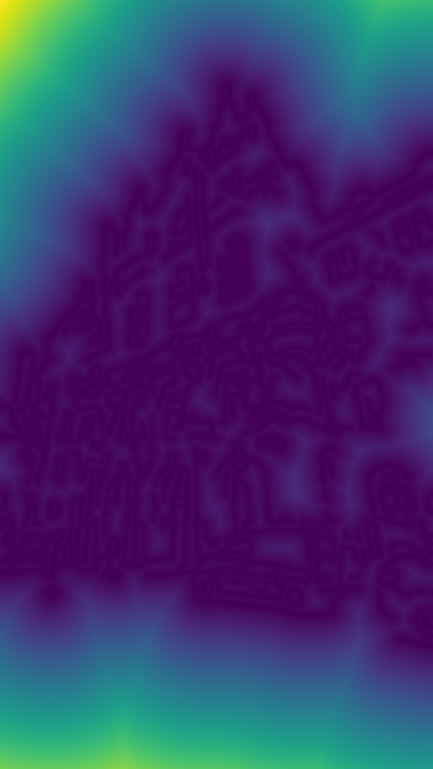
Given the initial geometry from a 3D Foundation Model, EPO computes for each image a Canny edge map and its Distance Transform Field (DTF), where every pixel encodes the distance to the nearest edge. Rather than matching features, EPO minimizes a bidirectional edge reprojection loss: edges from one view are reprojected into another and scored against the DTF. We learn, per scene, a pose MLP, a focal scaling, and a pixel-wise affine depth correction, all updated by a first-order optimizer until a pose-based stopping criterion is met.


Before
After




Pose Accuracy & Runtime
Using VGGT as a representative 3D Foundation Model, we compare against VGGT+BA and VGGT+Ref+BA which tracks are predicted by a CoTracker module. +Ref indicates further track refinement step. EPO improves pose accuracy (AUC@5°) on every benchmark while drastically cutting end-to-end runtime — and, unlike +Ref+BA (which needs ≥40 GB of VRAM), it runs on a consumer-grade RTX 4090.
AUC@5° ↑
Runtime (s) ↓
AUC@5° (higher is better) and total end-to-end wall-clock time in seconds (lower is better), averaged per dataset. EPO (torch) and EPO (triton) return the same AUC up to numerical noise, so the AUC bar is shown split between the two. † run on an NVIDIA H200 due to its higher memory requirements; all other methods run on an RTX 4090. These are the numbers reported in the paper, as of June 30, 2026.
Generalization Across 3D Foundation Models
Beyond RGB images for edge extraction, EPO needs only what any 3D Foundation Model already outputs — camera intrinsics, poses, and depth maps — so it drops in on top of different backbones unchanged. Applied to VGGT, MapAnything, π3X, VGGT-Ω, Deja View, and DA3-Large, EPO consistently boosts pose accuracy across every dataset.
VGGT
MapAnything
π³X
VGGT-Omega
Deja View
DA3-L
AUC@5° (higher is better) for six 3D Foundation Models, shown as raw output and after EPO refinement. EPO improves geometric accuracy across all models and datasets. These are the numbers reported in the paper, as of June 30, 2026.
Novel View Synthesis
As a downstream proxy for reconstruction quality, we train a 3DGS model for 30,000 steps on each SfM reconstruction. On Mip-NeRF 360, VGGT+EPO yields the best PSNR, SSIM, and LPIPS among the optimization methods, preserving sharper structural detail than BA-based refinement.
VGGT+Ref+BA vs GT
VGGT+EPO (Ours) vs GT
Garden



Flowers



Kitchen



| Method | PSNR↑ | SSIM↑ | LPIPS↓ |
|---|---|---|---|
| GT (reference) | 26.69 | 0.831 | 0.209 |
| VGGT | 20.56 | 0.555 | 0.422 |
| VGGT+BA | 22.70 | 0.661 | 0.339 |
| VGGT+Ref+BA | 23.06 | 0.688 | 0.320 |
| VGGT+EPO (Ours) | 23.93 | 0.721 | 0.284 |
Mean Novel View Synthesis quality on Mip-NeRF 360 (3DGS, 30k steps). These are the numbers reported in the paper, as of June 30, 2026.
BibTeX
@inproceedings{durso2026epo,
        title={Boosting 3D Foundation Models with Edge-based Pose Optimization},
        author={D'Urso, Mattia and Sormann, Christian and Rossi, Mattia and Fraundorfer, Friedrich},
        booktitle={European Conference on Computer Vision (ECCV)},
        year={2026}
      }